
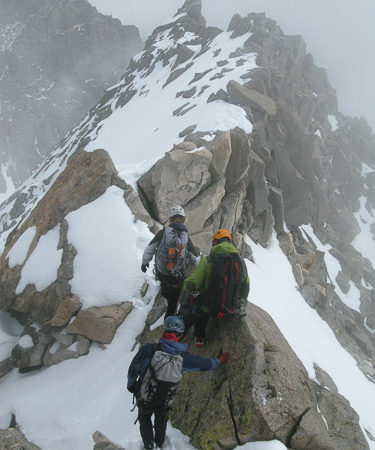
Today I ran into a local climber and mountain enthusiast in the Black Sheep Coffeehouse in Bishop. She worked for us as a porter and as a camp cook last summer, and I asked if she might be interested and available for some of that work again. She said “yes” but she explained that she just took a Wilderness First Responder course and has been hired by another local mountain guide service as a guide, specifically for trips on Mt. Whitney and in the Palisades. She has had no mountain guide training, and limited alpine climbing experience.

AMGA Alpine Guide Training in the Palisades
This scenario is way too common. A guide service owner/manager needs guides and recruits an enthusiastic, often young and/or maybe attractive climber, with the minimum medical certifications to be allowed to take on the role of “guide.” The same local company just last year recruited one of our part-time backpacking guides who is also a solid rock climber, had him shadow one trip on Whitney with a lead guide, and then sent him out to guide their paying guests in the Palisades with another barely qualified guide. They led climbers up an alpine snow and ice route that our guide service had already deemed too dangerous to climb due to rockfall danger. Reports verified that the route was extremely out of condition, but they climbed it anyway, and it sounded like they had some close calls. This was considered by the company as alpine guide training for the new guide. I don’t doubt that there were lessons learned, but I have to wonder what they were, and how they will affect future decision making.
How do people choose a guide service in this country? How do you know that your guide will be competent? Is it good enough that your guide be friendly, thoughtful, and spend more time in the mountains or on the cliffs than you do? Do you consider what you are actually getting for what you are about to spend? Now that you know your guide might be untrained, imagine if there were a way to ensure that they would at least have a minimum level of professional competency.
Land management agencies in the Sierra (and nearly every mountain range and climbing venue in the US) do not require mountain guides to have any guide training or certification whatsoever. They do require emergency wilderness medical certification which must be recertified every 2-3 years, but shouldn’t it be important to also require skills and judgment that can prevent accidents in the first place? If an accident does occur, proven competency in technical rescue skills may arguably be more important than competency in wound management, splinting a fracture, or CPR.
Land management agencies in the Sierra do not require mountain guides to have any guide training or certification whatsoever.
Of the 6 primary technical mountain guide services operating in the Eastern Sierra, only around 23% of listed guides are trained and certified in all of the aspects of mountain guiding that they work. Of those guides, 93% are employed by two guide services – SMG and Alpine Skills International – both of which have adopted similar hiring standards. These estimates are generous, since guide services are less likely to list their less qualified and newer guides. The number of Sierra guides even trained at all relevant to the terrain they guide is shockingly low. At SMG currently, 60% of our technical guides are certified in all of the disciplines in which they work, and all (except for one – full disclosure*) of our technical guides are at least actively on track toward certification in those disciplines. Our accident record and customer feedback do seem to reflect this.
Of the 6 primary technical mountain guide services operating in the Eastern Sierra, only around 23% of listed guides are trained and certified in all of the aspects of mountain guiding that they work.

Rescue skills assessment during an AMGA Ski Guide Exam
It is staggering to think, even now, that so many Sierra guides are untrained and unqualified when you consider the amount of technical skill, expertise, knowledge, and judgment required to make consistently good decisions in the mountains while rock climbing, alpine climbing, and backcountry skiing. As an instructor and examiner for the American Mountain Guides Association (AMGA) since 2000, I have seen how guides of various ages, backgrounds, and experience must push themselves to learn the skill sets and be able to demonstrate the ability to lead safe and enjoyable mountain experiences. To give you a sense, the process of becoming fully certified to the level of internationally recognized mountain guide (UIAGM / IFMGA) takes aspiring guides a minimum of around 4 years and over 90 days of formal training to achieve. In the Alpine countries of Europe, Canada, New Zealand and other international guiding venues, guides are not legally allowed to operate commercially without first acquiring a professional license via documented training and formal assessment. These places consider such training and certification a matter of public safety, and as such are regulated by federal government.
The US government has other priorities. Here, the customer must be responsible for their own due diligence. Can you assume that if a guide service is, and has been, allowed by government to operate, then they must be among the best and most competent? It’s kind of like trusting that old ¼” bolt protecting that 30 foot runout slab. It’ll hold… if you just believe. If you want to be able to rationally trust that you have a competent guide, you will have to dig deeper, pull back the curtain, shop around. Many of our smartest customers do just that. In many places there is still very little to no competition. For example, the only rock climbing guide service allowed in Yosemite National Park is run by the same corporate concessionaire that brings you the food and lodging in the Park – and let’s be honest, they aren’t going to be the highlight of your next Yosemite vacation (unless you are into cafeterias and hanta virus).
Guide training and certification should be administered by a third party. It is best if the curriculum and assessment methodology are in line with widely accepted professional standards. There are a few different training and certification organizations out there, all of which are valid and do a great service to the profession by attempting to raise the bar of competency. The AMGA program is the only one that has been evaluated and accepted by the IFMGA, representing the international mountain guiding community, and is also the only one that addresses standards for guiding in all 3 traditional disciplines of Rock Climbing, Alpine Climbing, and Ski Mountaineering.
One point of clarification though: beware of AMGA Accreditation. This has been a meaningless, if misleading, tag in the past, but at an AMGA round table meeting in Bishop last week, it was reiterated that starting in 2017 the Accreditation program will change to require all lead guides to be certified or actively on track toward certification in the guiding disciplines in which they guide. At SMG we have upheld this standard since 2006. We have been ethically opposed to AMGA Accreditation, and have spoken out strongly against it, but we now look forward to becoming AMGA Accredited as the standards change.

AMGA Ski Guide Training in the Ritter Range
I hope that this article will better inform those of you who may be looking around for a guide service or guide to take them to incredible places in the Sierra and beyond. I also hope that this will serve as an open letter to those local guide services who still willingly sell the services of unqualified and untrained guides. Those who hire guides are slowly learning and that way of doing business in this industry is surely coming to an end. ~ Howie
* The one SMG rock guide without any AMGA training or certification is Peter Croft. Peter has been eligible for AMGA grandfathering in the past and has respectfully declined that opportunity. He has guided on rock for more than 2 decades and is considered by many to be one of the few true masters of the art of rock climbing. He learned to guide, as many have, before certification and fortunately he was able to gain the expertise in the trade through apprenticeship, experimentation, and being open to new ideas. He has been vetted within our company for sound overall guiding practices and expert rock guiding skills and we have considered him a justifiable exception to our company’s rule. He is an exceptional individual, and he has stated that he is still considering the idea of pursuing AMGA certification as part of his continuing professional development.
Comments
Thanks for all this info you guys. A lot of new ideas for me. Reading a bit about it, I am still in favor of having a standard in spite of any added complexity. I think the industry needs to realize that: a) there is already an international industry standard that has been in use and continually developed for several decades (IFMGA), and b) that the US has some unique challenges that should be addressed by developing complimentary standards for training, curriculum, and assessment.
Rick, I think most of the mass guiding that you are referring to is low-level and certification could be easily achieved. Plus, there would probably be some kind of grace period before any regulation would go into effect. Small price to pay to ensure that guides out there are professionals within their terrain limitations, I think. The AMGA had a “contract” guide training program for intro IFMGA-track courses and SMG was a part of that. The organization put an end to it. Although it made for easier access to programs and more competition in pricing (and we had a lot of fun teaching them here in the Eastern Sierra), the AMGA was having a tough time with oversight and consistency. Ultimately, unless there is a good system in place for instructor training and oversight, it creates major potential problems later when people show up for continued training and assessment. The SPI and CWI (non-IFMGA-track) programs still operate this way, and because these are lower level cert’s that require CPD renewal it seems to work ok.
The Wilderness Medicine model is an interesting one for comparison. In a relatively short time they have developed a national standard that has become a standard requirement in the industry, has raised the bar for professionals, and has figured out a way to accommodate competition in the marketplace. This is all in spite of the apparent confusion about the different acronyms for schools: WMI, WMO, WMA, SOLO, etc. It will be best if any new standards are in compliance with existing standards for similar industries, but ultimately if there needs to be a difference then perhaps it can stand as industry specific. We have seen this happen in wilderness medicine as well (for example – the administration of epinephrine by Wilderness First Responders in certain backcountry emergencies).
Again, I agree that there is no need or benefit to a monopoly – other than that it is ensures a single standard and control over it. There needs to be a unified and nationally accepted educational and certification standard as it begins to become required by public land agencies and insurance companies. I do believe that this will happen sooner or later (probably sooner) and the industry should get it together to be proactive. The confusion about standards that has been created by the emergence of competing organizations is the only real issue I have about them. That is why I suggest a third party organization to create, administer, and support professional standards. The details of why choose one school over another should be market driven – quality, methodology, price, value, locations, terrain access, logistics, staff, reputation, etc. Once the bar is set, then let the competition begin, and everyone will benefit. I hope someone with more influence over things than me takes note of this discussion. Thanks again!
I agree the ropes course industry has shown us the way NOT to do it. I also agree we need to look to a third party someone that dose not have a financial stake in it. The NFPA puts out more standards to a larger diverse industry then any of the climbing organization. Maybe their model would work. I agree some thing is going to happen and some things are already happening. Because there has been accidents and death in the ropes course industry may states have pass legislation, and all there needs to be is a word change from “All ropes courses activities” to “All climbing activities” and that will be the law for rock climbing guides.
Un less these three groups can get it together I am afraid a third party will write the climbing industry standards and no one is going to like it but it will be law. What Europe dose and thinks really dose not matter, it is going to be the law we pass that do.
Four years ago when I looking in too professional guide training, and spent lots of time looking in to all three organization, there was only really one comment, what a shame all that talent and energy wasted on personalities.
But Howie, the real guiding training problems are at what you call the lower end guiding. The Boy Scout, camps and youth organization, the non-so called professional groups. But none of the three organizations are reaching out to them.
Because the attitude is “o” just come take the SPI course, we have it all figured out. That is not how you treat your great grand father. You have to build relationships and under standing’s. The biggest problem there is no money in it.
This just came out today.
http://recreation-law.com/2014/06/11/ansi-astm-prca-acct-nsaa-a-mess-of-acronyms-that-are-fighting-each-other-taking-your-industry-down-and-wasting-money/?fb_action_ids=817276438285537&fb_action_types=news.publishes&fb_ref=pub-standard
This is why when people start talking about standards, and creating them it gets very messy. Un-fortunately you can replace the words ropes course with rock climbing; ACCT with AMGA and PRCA with PCGI and you pretty much have the same history.
If the AMGA wants to continue down this road, how could it avoid this kettle of fish or should they drop that whole standards idea all together?
Remember certification and standards are basically the same.
Of course, there is over 50 schools in the USA that you can take rocket science… (not just one monopoly/concession – AMGA)!
Rick, the CWA is huge and solely focused on the climbing wall industry… doesn’t it seem to make sense that the AMGA work with them (or that they are better suited to deal with CWI)? Also, the PCIA and PCGI, while focusing on rock, cover a lot of the same curriculum. I mean SPI curriculum isn’t rocket science…why should the AMGA be the only folks able to certify folks (although independent folks can cover cwi/spi curriculum/grant certs.) and be recognized? In Canada the ACMG has accepted another ski guide training/assessment to be “on-par” for certain terrain and mechanized skiing.
With ACCT and PCGI setting legal standards for climbing walls in the Unites Sates. I do not think CWA even has a clue.
This is one of my points if you do not pay attention of the other related industries you may get blind sided. I my onion both the CWA and the AMGA CW program already got sucked into this and they did not even know it.
Howie, regardless of anyone’s views, your tact and approach to this conversation is remarkable! You are a true gentleman.
Dave, you know the difference between god and a mountain guide right? (God doesn’t think he’s a mountain guide.) In all seriousness though, whether or not the AMGA takes the slice of humble pie you are offering them is pretty much irrelevant. The AMGA is still outperforming the competition in terms of training and certifying guides. AMGA standards may become the de facto standard at some point in the near future because they are the largest organization involved, they have been doing it the longest, they deal with more facets of mountain guiding, and they are accepted by the IFMGA. For better or worse, it may be that the PCGI and others will have to adapt to whatever results from the AMGA’s initiatives in Washington DC and elsewhere. I think one common standard across the board would be best, regardless of how it all goes down.
Abe, I agree with your paradoxical point: that formal training/certification is not required to make a great guide, but that education is great and very important. It seems that it is hard to promote certified guides for their level of expertise without coming off negatively about uncertified guides and inferring that they are incompetent. This is of course not the case, as a generalization. I will say that I have not met a guide, beginner through veteran, that has not claimed enormous benefit from the training and assessment processes they participated in. Having been through it myself, I do not believe that these guides are biased in defense of their investments, as you suggest. I have seen 50+ year old veteran guides of many decades spend their money and time to continue their development. I don’t think it can be accurately characterized as a clique when all are so actively being invited to join. It is hard to argue that a trial and error, on-the-job training approach is more efficient or effective than a formal education process as a path to competency.
You do point out some real holes. The process is far from perfect. It is the premise that I am in support of, not the details. To my knowledge, the valid issues you mention are all in the process of being addressed by the AMGA. There has been recent talk in the AMGA of making a less rigorous level alpine cert for glacier and expedition guides as well as for mechanized ski guides. I think these are good ideas. Requirements are incorporated in the new proposed terrain and supervision guidelines, which are designed to prevent guides from working independently without a minimum level of apprenticeship. This is a good step forward. For IFMGA membership there must be a continuing professional development requirement. In the AMGA there is one, but it is currently very lax and not actually being tracked. This is understandable considering that certification itself is not yet required to guide at all on public lands. Once this changes, the CPD requirements will undoubtedly be increased and regulated as it is in other IFMGA countries and other professions.
I think more people have to get more involved in the discussions that are already taking place so we can keep the conversation moving forward. Thanks for being a part of it!
I think that is the hole the AMGA national is digging them self into. Wanting national certification with a small group of people trying to put on a limited amount of training at limited locations for 350 million people. If for some reason the United States said you have to have a certified guide to take a group climbing on all public lands. Two things would happen 90% of the climbing would stop, and it would be ten years just to get into an AMGA certification program.
They cannot create more and more national training programs and expect to meet future demands. They need to let it go and turn all the training over to accredited training centers like Sierra Mountain Guides, and all the other established organizations and companies. Just think if certification was bases on number of days taking class and not just a one-time visit.
I would like to take the RI class but it is not for six month or next fall. My money is going to other things. But if I could take the same class at my local guiding company, the money stayed home and I can do it on four three day weekends and not have to take off for my day job. I could also customize my RI training based on my past training and experiences.
The bottom like it is all about control, and who has it.
Also, every # of years you need to “re-cert”, pass the bar, etc… what about aging guides/folks that take off/take time off being in certain terrain? Only CWI and SPI folks that arguably actually spend the most amount of days in their terrain!?
Most all re-certification of professional degrees are based on continuing education, not taking an exam over and over. It is kind of funny the RI and above get to do that but not the CW or SPI.
Actually Dave,
I think the education is great and very important (whomever it’s from). I have just seen incredible guides in the Himalaya and all over the world that work the great “slogs” and shouldn’t be knocked because they don’t lead 5.10 trad or ski guide… I also think that many of the folks are mature adults and an assessment vs. the course is completely different. After a course it should be apparent what you can and cannot do… as a professional, you cannot guide things you are uncomfortable with! I see these talks/debates and it always seems like it’s the folks that have put the most investment in the courses/exams that are trying to justify it all (duh), but it just keeps making it seem like a big clique’! I have seen many highly trained guides blinding their judgement and ignoring local resources/”lesser certified” but more locally knowledgeable folks just because they are “above them”. As certification becomes more common, people are actually guiding independently sooner than when a lot of experience (extensive) and apprenticeships were required. Lastly, I see the folks you speak of that got fully certified and then stopped working in certain environments, got injured, pursued another path, had babies, etc. but are “all set to go” when they decide to take up their old hobby again!
Howie the AMGA name is no deal breaker for me, I value my training and time spent with others from the AMGA. I think that the organization needs to realize that they are not ‘god’ when it comes to US guiding regulations, permitting and certifications. As Abe said and you’ve said , there are quite competent and experienced guides who don’t have an ounce of AMGA training.
But I’m over that argument and am interested in the idea of a third party oversight organization non affiliated with the other major organizations. So, yes, I would be interested.
Hi Abe,
Yes, it is all way too confusing. First, I don’t think I would go so far as to say IFMGA guides are on a par with doctors, but there is some basis for comparison in that they study and must pass exams in order to practice in their profession. Just like pilots, doctors, engineers, plumbers, etc. I don’t think we can say “what the AMGA wants,” because it is an organization run by an ever-changing board of directors, elected by guides, with an often evolving mission statement. It turns out that the majority of the electorate are currently uncertified guides. That might help explain some of the mission creep and apparent lack of direction within the organization with respect to advocacy of certification. The current mission of the organization is: “to inspire and support a culture of American mountain craft.” As you can see, this statement stands for very little of significance and is broad enough to include pretty much anything and everything. Their previous mission was to be the premier source for training and credentials in the US (or something like that). I think we can infer that the AMGA would still like to be the main provider of training and credentials. It has never dared to state that it is opposed to concessions. In fact, at one time in recent history the mission included “to maintain the current system of permitting and land access for guides in the US.” They removed that with a change in directors and, in part, because of their responsibility as an IFMGA member organization to work toward changing the system to allow for foreign guide access. I don’t think any of this has to include breaking concessions. I do think that concessions will need to be opened somewhat, at some point, and on some level in order to fully support certification, but it is also remotely possible that everything could work through cooperating concessionaires.
All IFMGA guides must demonstrate their skills and abilities in the disciplines of Rock, Alpine, and Ski (except in certain countries such as Bolivia and Nepal, which is controversial and may be changing). They may live in non-glaciated environments but travel to glaciated ones for work. That is considered normal and acceptable. Many IFMGA guides have needed to develop skills in weaker disciplines in order to get the full cert. Many IFMGA guides specialize in only 1 or 2 disciplines after becoming certified and their expertise in some aspects of mountain guiding lapse. The same could be said again for doctors. And the same can be said for Canadian and European guides. Just because a guide lives close to terrain, doesn’t mean they are out there working and playing in it, in all disciplines year round. I know guides who live in the desert southwest for example that guide actively in all disciplines worldwide and they remain very sharp all around.
I also agree that a dedicated rock guide, for example, could be way more proficient than an IFMGA guide. That is why the AMGA treats a Rock Guide Certification equally to an IFMGA cert in regards to rock terrain. And your point is important that there is more to look at than certification. That is just the base level, the minimum technical standard. It is most often well beyond certification when guides develop mastery in their specialties and venues in which they work.
I am having a hard time understanding a few things. I often hear IFMGA guides refer to their level of certification on par w/ doctors, etc. A doctor can get their education from any number of schools across the country (and all over the world). The AMGA wants to be the sole entity for guiding in America yet is opposed to concessions? Also, I am seeing a lot of folks getting IFMGA status from places that do not have real mountain terrain, glaciers, anything longer than grade III routes, etc.? These folks go out and do a few trips in the west a year and are qualified to guide in that terrain? In Canada and Europe people live and work in that terrain year-round. Lastly, the US is a different beast on many levels and a rock guide can work year-round and be the best in the business and not be IFMGA!
That’s what I’m talking about Dave, except I think it should be an organization branded and marketed strongly. Ideally it would be the AMGA, as an association of trade professionals. The AMGA name has built decades of brand recognition and credibility so I think that would be the easiest and most effective way to do it. Could you get behind something like that, or would the AMGA name be too much of a deal breaker for you? Then the AMGA’s current training and certification program could spin off as a school like ENSA (in France) or Thompson River U in Canada with a different name. PCGI and others could be competing schools that all use the same industry standards for training criteria. No need to excommunicate anyone though for being based in Boulder. Not sure why that would be an issue for you. This ought to be an inclusive endeavor that includes broad support for nationally and internationally accepted standards for guiding. As you say, a neutral 3rd party platform that supports the profession and advocates for American guides. The AMGA is going to have to split the training/cert from the advocacy eventually due to inherent conflict of interest there.
That is what the ANSI is all about One of the ANSI criteria is to have international compatibility, and the AMGA has that.
Form a guides union. Something completely un-affiliated with any training organization yet comprised of respected and accomplished guides, of all disciplines from every corner of the country. No boulder-centric folks, instead have a representative from each major region where guiding is a viable occupation. That person could be voted on by all the major outfits of the region, and appointed to the advocacy group. They listen to the traing orgs, the guide services but most importantly they advocate for and support the individual guide within the larger system. Essentially leave the training to the training orgs, and the union can focus on creating a REAL voice for everyone, hopefully from a neutral platform with the end line goal of supporting the profession.
Thanks everyone for keeping this discussion going. I am actually quite amazed at the brilliance of many comments and perspectives coming out of it. We have been grieving the loss of Matt and the 5 others on Mt. Rainier as many others of you are. Let us remember that we, as technical climbing and skiing guides of all levels and backgrounds of training, certification, experience, and ability, in all of the wonderful mountains and cliffs on Earth, are all brothers and sisters bound by the same passion and motivation to provide people with the safest and most enjoyable experiences possible. Those who hire our services give us the gift of their trust, and an opportunity to live this passion with them. I can’t express enough the amount of respect and admiration I have for all of you – guides and guests of guides alike, especially those of you who care enough to listen to and participate in this discussion.
This will intend to respond to some of the questions and comments by Dave, Kate and Rick, from my perspective.
Kate – Thank you for your keen insight. The US is not as far along as Canada and other IFMGA-member countries in the evolution of the profession. We have not yet supported a system whereby guiding services must by rule of law be professional (and by “professional” I do not just mean “paid”). Without industry norms for hiring based on training and credentials, there is no requirement for a level of expertise from a guide that demands a fair wage based on this expertise. In addition, as Dave points out, the public is under-educated about the benefits and value of an experience with a certified guide. This limits the demand for certified guides. Limited demand results in lower prices and lower wages. True that this reality is somewhat appalling, but we are now asking what can be done about it.
You should also realize that in the US, a technical “guide” ranges from an indoor certified Climbing Wall guide or Single Pitch outdoor rock guide to an IFMGA-level ski and full mountain guide. There are many types and levels of guide in between. Just look at this image from the new AMGA Logo Use Policy that depicts logos to be used for 17 different categories of American technical guide:
http://www.sierramtnguides.com/?p=3381
Should a boy scout leader leading a troop on a day of toproping at the local crag earn the same professional wage as an alpine guide on the Matterhorn? Doctors specialize too and not all of them receive the same levels of compensation for the medicine they practice.
Dave – To your questions and comments, SMG pays our top rates to IFMGA guides which fall within industry norms. Personally, I think the wage is too low for the job that they do, but this is what we pay based on the fact that their expertise is generally used on low ratio (low to zero margin) programs. We break even on most 1:1 ratio programs, but we run them anyway because we think they are amazing. American guide services doing business in the Alps for example charge up to 50% more per day than what we are able to charge to be competitive here in the Sierra, and they have far lower overhead costs. Guides who are only trained enough for single pitch rock guiding in places like the Owens River Gorge or the Mammoth Lakes Area generally have far less formal training and investment in their education than an IFMGA guide. We think they should earn a lower wage. To summarize my opinion, at this time $200 is too low for a highly trained and certified guide and perhaps too much for a low level guide.
I fully agree with your point that not all IFMGA guides are cream of the crop. I have seen IFMGA guides in the Alps do things that I thought were completely irresponsible and downright dangerous. I have worked within the AMGA certification programs for over a decade and have seen how its assessment systems are far from perfect for measuring a guide’s knowledge, judgment, and ability. I have also seen guides with no formal training whatsoever develop into wonderfully talented and competent guides. None of that makes me think differently about the value of certification for our industry.
Regarding any AMGA/PCGI conflict, I admit that I don’t fully understand the tension there, but I do think that it would be pretty normal to see competitors in this context claim superiority over one another. It seems to me that the PCGI is just as culpable as the AMGA with regard to your criticism.
I do love your ideas and suggestions. And I agree with you that the AMGA and PCGI both help to make the profession stronger with training and certifications, as I stated in the original article, but I think one national standard that we all support would be a far better way to go than multiple standards developed and promoted independently.
…which leads to Rick – I really value your ideas here, particularly the one about ANSI. I wonder if such an agency already exists that can help to develop and promote standards? Could an outside agency give us all one unified standard with multiple ways to get there? We did this within the AMGA with avalanche education providers. We developed a written criteria for accepted Level 2 and 3 avalanche courses as prerequisites for entering AMGA programs. This is an example where the AMGA was able to use the power of the demand for their certification to affect the professional avalanche education industry.
So it should be clarified that AMGA programs actually do look at experience, abilities, and outside training within their programs as part of their prerequisites. The problem that Dave mentions comes from either poor screening of prerequisites (a problem more of the past than the present) and in my opinion prerequisites that are not rigorous enough. In some IFMGA countries there are entrance examinations that ensure a minimum standard of movement skill and fitness, and in most there is a higher standard for personal resume. I think this is inevitably the way it will go in the US as well, but it won’t fully get there until certification is required, seen as having more intrinsic value, and that there are so many people wanting to be guides that the educational organizations can be more selective about who is accepted into their programs.
~~~~~~~~~~~~~~~~
The AMGA is getting close to a critical point for the organization. At the round table discussion I asked representatives what they plan to do for certified guides beyond just training and certifying them and pursuing certification/accreditation based access. Their response was that they want to do more but that they don’t have a lot of ideas or direction on the matter. I think at some point the AMGA will have to choose whether they want to be an educational organization or a professional trade organization. They appear to be trying to be both which is an enormous task. Because the primary revenue source comes from the educational side, their efforts are mostly focused there. This has left a void where there is a great need in the industry.
A professional trade organization would be able to advocate for trained and certified guides in a beneficial way. It could provide oversight of guide training programs and third party administration for professional credentials. It could advocate for certified guides by increasing wages, decreasing the costs of doing business for guide employees and employers, as well as increase benefits for guides and those who hire them.
I wonder if such an agency already exists that can help to develop and promote standards?
I have followed and participated a little in the ACCT ANSI standards process over the past three years, and the ANSI gives you guidelines on how to develop a national standards. It is real not that hard. But you have to have people that can lessen to others. RTK
Could an outside agency give us all one unified standard with multiple ways to get there?
Good standards are like the Law lots of generalities with not much detail. RTK
I think at some point the AMGA will have to choose whether they want to be an educational organization or a professional trade organization.
Very interesting comment. RTK
I think as an organization the AMGA needs to get out of the educational business and more in to the standards setting business and let the professional trade side of things runs the educational side of things. Everyone makes more money and more people are trained. RTK
I think the biggest problem is the narrow definition of what is a guide that is held by both organizations. Until they broaden their view you will never reach the public as you suggested.
I have been thinking about the concept of recreational guide, because all of us take family and friends out climbing.
Nice Kate, it’s awesome to hear from a client who understands and respects the profession.
Rick, I agree. Can the AMGA play nice with PCGI or will the superiority complex continue. I believe, with the new AMGA president we will hopefully see some change since he has obviously had his own issues with his organization in the past. I know there was some bitterness between the two orgs in the past but hopefully they can move beyond that, find some common ground, make the guiding industry stronger, continue to provide high levels of training and certifications and together produce a favorable view o the profession in the US. After all, despite the differences, the end goal is the same for both organizations.
It seems most folks agree that raising the publics awareness of the value guides provide is key to moving the profession forward. As the AMGA holds this traveling round table discussion, annual meetings etc., it seems to me that what we need to do is bring that awareness to the public. How? Maybe start with a presentation at local climbing gyms, guides are all over the country, maybe spend one evening at a gym doing a presentation. Imagine if a cert. guide from either if the 2 major training orgs. Did that around the whole country, a ton of people may get enlightened to something they really have no idea about. Lots of climbing shops do presentations to, of joe blows rad ascent somewhere or whatever, A-16, and REI come to mind. A local guide could give a quick presentation before the big show. These are some quick ideas but some how I think that informing the consumer would be a great place to start. You can’t buy what you don’t know exists!
Also I’d personally like to see the guide training organizations and guiding services do more than solely work on permit acquisition. Kate above had some great points regarding insurance, a living wage, time off to vacation (there is other cool places besides the mountains) relax, get psyched up to get out there and be the best guide
you can. It’s easier when you feel respected and valued for what you are doing, which at the basic
Level is providing a safe enjoyable experience, feeling confident that who your climbing with really does know what they’re doing.
US Rock and Alpine Guiding Standards.
The only non legislative approach to setting US national standards is through the American National Standards Institute (ANSI). This would solve the problem that insurance companies might have with guide trainings, and would not require congress or government agencies, because the ANSI is already recognized by them.
I am pretty convinced that the Association for Challenge Course Technology (ACCT) and the Professional Ropes Course Association have for all practical purposes written the US standards for climbing walls. So a Rock and Alpine guiding standards dose not need to cover that aspect of wall climbing.
The PRCA and ACCT took five years to put their plans together. I thing we could do in 1-2 years. Most of the generic terms are done.
The most difficult task will be convincing all the groups to play together. Can AMGA accept PCGI and BSA training? Can PCIA return to the fold? Will NOLS and Outward Bound want to play? Who ever take this on will have to get all these groups to agree. Imposable no, but it will be difficult, if the approach dose not remove any band speciation’s. or it will never happen. Can the AMGA be the leader of this effort; I think they already are, but the real guiding world in the United Sates is a 100 times larger than what is considered professional guides, such as AMGA and others.
A start towards this would be to add educational and experiences requirements to all the AMGA certifications, not just a one time evaluation. This could also be very financially beneficial to existing instructor pool course providers. For example the SPI could require re-cert to have say six days of training that is taken from SPI course providers. It could be any course they give any time of the year, all over the country, to replace a second SPE. With about 350 SPI students each year, for the next three years you could bring in about $250,000 or more in year for course providers, because you would have to take courses from course providers to keep your cert up.
Just a thought.
Rick
A few respectful comments from a non-guide – i.e. a guiding client – from Canada.
I find it almost appalling that someone would think $250 a day is too much for a guide. From my understanding, that’s about the starting rate for an assistant guide at the company I’ve done all my courses/private trips through in Canada. Certainly, I wish that courses/private guiding were more affordable, but I think every penny I’ve spent is well worth it in terms of well trained, qualified and personable guides.
My understanding is that full ACMG certification here can take up to 10 years and $40,000. But from my experience, it turns out guides who are not only technically able, but are talented in teaching and people skills. Which are every bit as valuable from a client point of view. What good to me is a guide who has years of experience and great technical skills, but can’t teach them to me or makes me feel uncomfortable/nervous?
As a client, I also feel it’s really important that a guide be able to make a decent living. Why would I expect that a highly trained guide be willing to accept a salary, when I wouldn’t do the same in my field? A guide should be able to afford to cover living/housing/medical/insurance expenses, support a family and, gasp, take a couple of vacations. When I go out into the mountains with a guide, there’s a fair bit of risk there. I would much rather take that risk with someone who’s not stressed out from working 200 days a year to make ends meet, and doesn’t have enough time to relax with friends and family.
From a more practical standpoint, and perhaps because I live in an area with a lot of guides, guides and others in the mountaineering community are as much a part of the economy as any other profession. If guides aren’t making decent pay, then they aren’t spending money at local businesses, buying and renting accommodation and paying taxes. All of those keep our economy going, and thus, allow the government to pay my salary. I may complain about my salary on occasion, but I make more than most guides and there a lot more of us PhDs out there than ACMG guides.
I do think guide certification, and certification that means something in terms of both technical, teaching and soft (people) skills is very important. Initially, as someone new to the mountains, I was fortunate enough to get good recommendations for a guiding company and luck out with a great guide who I have continued to learn from on courses and private sessions. Now, with some experience in guided and club trips/courses under my belt, plus the chance to have some long conversations with guides and people with years of experience, I know what to expect/not to expect/industry standard and what questions to ask when ‘vetting’ a guide or company. But I recognize that I’m probably in the minority in terms of clients, and there needs to be some way for new clients to be able to judge guiding skills and expertise, and not just from a bio on a website. At least here in Canada, unless someone is skirting the law, you know you are getting a certain standard from any trip run in a national (or provincial) park. Plus, all assistant and full guides are listed on the public ACMG site, so it’s easy to check on any claim of certification.
Anyway, just a few thoughts from a client and relative newbie to to mountaineering…
Dave,
Great points and I want to get back to them.
It is with an extremely heavy heart that I have to share the tragic news that our guide Matt Hegeman was killed, along with another unidentified guide and 4 clients on Mount Rainier’s Liberty Ridge while guiding on the mountain for Alpine Ascents International. This information was reported by the Seattle Times here:
http://blogs.seattletimes.com/today/2014/05/six-climbers-missing-on-mount-rainier/
We are all stunned, heartbroken, and just very sad.
Oops, sorry, didn’t mean to post there. Anyways, what I see is that the AMGA is turning into a puppy mill. They have goals of certifying ‘x’ number of guides per year, I think the vision of creating knowledgable, highly experienced, and highly trained guides is getting lost on trying to play a numbers game where personal experience and accomplishment is getting placed second to training. Both of which should be equal.
Howie, I agree with MOST of your points, heck ALMOST all of them. The problem I see is that, as guides, we are expected to have the utmost in professional demeanor, which is understandable however there are very few guide services who offer a professional rate of compensation. Rick up above says $200/ day is too much. Do you think that is to much? As a father, home owner and guide of 15 years, 9 with YMS, I couldn’t support my family with what most guide services are willing to pay a ‘professional’. How many of your guides get health insurance through your service? Sick pay? Vacation pay? Just wondering! What does an IFMGA guide, excluding yourself and Your partner, get paid? $150 if certified and working within their terrain? IFMGA cert.? $190/ day? Just wondering. I couldn’t work any job for less than $200/ day, and that still is’nt considered the pay of a ‘professional’, and fortunately I don’t.
Untill the consumer can be convinced or made to understand the value they are getting with someone who knows their stuff the profession will continue to struggle from all sides of the service provider.
And also I don’t agree that all certified guides are necessarily the cream of the crop. Can you honestly say they are? I’ve seen numerous guides on the track who only barely, if at all, meet the MINIMUM levels of personal experience that is supposedly required to enter into the basic level of AMGA training. I have seen lots of people itching to get into the program,’ if I could only get one more grade 4 on my resume
Hope all is well.
Also want to interrupt this discussion in light of some terrible news that one of our guide friends may be in trouble on Mt. Rainier. Please join Dave Miller and I in sending all of our best thoughts and energy up there for a good outcome.
Dave,
You are misquoting my comments about YMS and taking them out of context. Your point is taken though. A few comments made here and on a parallel Facebook post where we have been debating the issue are made by non-guides. Was just approached tonight by a schoolteacher in Bishop who commented that this thread was very interesting to her. Looks like one person’s rant is another’s food for thought. Of all places to speak my opinions I would think a post on my own blog would be among the most appropriate. I mean no harm to the good folks of YMS, many of whom are dear friends. I am just making a case for guide certification from this side of the range. Still waiting to hear a stronger argument to the contrary if you or anyone else has one.
Well I can appreciate this conversation and agree with many points addressed I also see some issues.
You also mentioned YMS, indirectly. Something about being run by people who sell burgers (bad ones) and hanta virus to their guests. While DNC does provide the concession as required by their winning of the bid to provide such services, YMS is run by a former member of the AMGA’s board of directors as well as a cert. rock guide who has more experience in the terrain in which he manages than most anyone in the AMGA. While I’m quite aware of the guide service you have decided to use as an impetus to your rant, this is not place for it., whether I agree or not.
Also I find it very reflective that once again the only people, including myself, that are hashing this out are guides and guide service owners.
If the public cared maybe they would respond with their thoughts. They haven’t. The only people trying to make this into something that Europe or Canada may have is the ones who are trying to make copper out of a penny, not the clients. Which is sadly the case with this profession in the U.S.
Hey thanks Rick. Thanks for expressing your opinions in a respectful way too. This topic sometimes brings up the demons in guides for some reason, but glad this thread didn’t quite go there… yet.
This is the most respectful discussion on the topic of AMGA guide certification I have ever had the privilege of participating in, most AMGA guides I have talked to just go ballistic if there is any difference of opinions or even talk about not being a good idea.
Thank you
Josh,
Interesting point. Yes, I agree that the European model is not realistic at this point for the US. I also agree that insurance companies might be the game changer for requiring Accreditation/Certification.
Interestingly, was just talking to one of the AMGA board members and they had mentioned that in European companies there are significant liability controls on the guide. For example, in Italy, if a client is buried and killed in an avalanche, the guide is criminally prosecuted and often goes to jail. In the US, the information might not even be made public and it often ends in a non-disclosed settlement. Anyway, not sure if that helps add to your point but it seems that being unregulated has it’s good and bad sides for the industry, but I would think there is more positive effect for the public who hires guides.
I have read about European prosecutions; scare the shit out of me. Lots of things happen in the woods, that you have no control of. Look at the 50 people sitting in their homes in the state of Washington and a land slide mows them down.
Dave,
To respond to your comments and points:
Your company, California Alpine Guides, was not included in this analysis. This is because CAG does not hold Priority Use permits on the Inyo National Forest, where most Eastern Sierra guiding occurs. I can see from your perspective that you may have thought CAG was included and taken offense to that. Hopefully you now understand otherwise.
This post does not make the implications that you state. I did not say that all other guide services are hiring inept guides. It does appear from a cursory look at the facts that they are often currently not hiring trained and certified guides for all disciplines these guides work. This means that there is a relatively high probability that if chosen at random, the public will get a guide without certification that applies to the terrain where they are going. This is a sobering fact and one that can be easily addressed by simply adopting a more rigorous hiring standard, as done by SMG and ASI (among a few others in the country). We suggest that clients not choose their guides at random. They should go with companies that have openly committed to this standard. New AMGA Accreditation will be one useful way to separate the guide services in this regard.
If these facts and the new Accreditation standards make our company look good and others look bad, then let the chips fall where they may. I acknowledge in the article that there is more than one way, outside of training and certification, to become an excellent guide, and that even one of our guides is untrained and uncertified for their discipline. I don’t expect that all companies will be willing or able to adopt the new standard overnight, but keep in mind that they do allow for “grandfathering” of guides working for accredited companies since 2008. I know that the AMGA is going to do everything possible to help companies meet the new standards by 2017.
Guide services that continue to choose to hire guides without professional training/credentials in the terrain they work as part of their hiring practices should feel free to defend that practice against a wave of professionalism currently overtaking the industry, or understand that they will be called out and judged by those who hire guides and know the difference.
Hi Ryan,
I’ll be the first to admit, in regards to the numbers, this is far from a scientific study. The statement I made that you call into question is:
“Of the 6 primary technical mountain guide services operating in the Eastern Sierra, only around 23% of listed guides are trained and certified in all of the aspects of mountain guiding that they work.”
Read this carefully, because it relates to technical mountain guiding, not backpacking/hiking. I probably could have made that more clear with the way I wrote it, but it does say it explicitly. Secondly, we are talking about listed guides that I know do actively work for the company. It is easy to look these guides up to see if they are certified in a given discipline (and if they are then they are presumably trained as well). Where error may exist is in that I do not definitively know which disciplines all of the guides actually work in, but I was able to get a pretty complete picture of it. The other source of error, which I pointed out, is that some active guides may not be listed by guide services, usually because the guides are new or and/or less qualified. I suspect that this makes the numbers I used skewed in the conservative side.
The method I used is to simply look at listed guides on respective websites and make the count. I did not count non-technical guiding. I used the 6 primary local guide services: Sierra Mountain Guides, Sierra Mountain Center, Alpine Skills International, Sierra Mountaineering International, Sierra Wilderness Seminars, and American Alpine Institute. Repeat the study for yourself and let us know your findings. Like I said, it is a pretty rough study, but it still sheds light on some of the realities of what is going on in the Eastern Sierra.
To your other question, I did not hear that the AMGA is looking into a hiking certification at this time. Personally, I think they have their hands full and they should focus on the technical guiding standards before they try and tackle that one.
As someone who went through the huge expense and time of gaining IFMGA cerification I agree with the bulk of the case for certification above. However, some of the stats listed are misleading and not constructive. My guide service, California Alpine Guides, has for the last couple years hired AMGA certified or trained guides for over 90% of my technical trips. I agree overall with the AMGA’s new accreditation program and plan to implement it fully by 2016. In fact, before I even learned of it’s details the other night at the roundtable, I was already making an AMGA trained and certified requirement for technical terrain within my company.
However, and this is huge, we as guide services are in a transition phase towards that. I have one guide for example who guides routes for me that involve snow slopes up to 35 deg and mellow 3rd class rock. He has five years of previous big mountain and glacier experience on Mt Shasta. But he does not have any AMGA training. I told him last year he would have to get some AMGA training for this year. He was not able to enroll in a Rock Instructor course this spring because the AMGA had no space for him. What am I supposed to do? Lay him off for the season because the AMGA can’t run enough courses?
It’s not easy running a guide service and scheduling guides, especially with last minute bookings, etc. It’s almost impossible to do it with all certified and trained guides in the discipline they are working in. There’s just not enough certified and trained guides out there yet. But I have managed to do it 90% of the time for the past year and next year it will be 100%. All guides who guide rock (including High Sierra rock) will have AMGA rock training, all guides who guide glaciers will have AMGA alpine or ski mountaineering training, all guides who guide on skis will have ski training either through the AMGA or similar outside organization. As it stands right now, 88% of my technical guides listed are certified or trained by an outside organization for the terrain on which they work. 100% are certified, trained, or awaiting AMGA training. (I have a number of backpacking guides who for obvious reasons are not seeking AMGA training)
As hard as I (and my guides) am working towards this goal I don’t appreciate another guide service appearing to call ALL the other East Side guide services out for not hiring certified and trained guides. it just seems like a crass competitive move and not constructive.
Yes, there are guide services out there that hire people “off the street” that perhaps shouldn’t be guiding the terrain hey are on. But it seems you are calling everyone else out and lumping them all together. And as far as I know, I am not the only other company that operates in the Eastern Sierra that does not hire people who should not be guiding on the terrain they are on. The blog post above seems to infer (Yet not directly state) that all companies based on the East Side except for SMG (and ASI in Truckee) are hiring inept people to run their trips. This is flat out not true and to infer that is simply sowing the seeds of discourse once again among guide services along the Eastern Sierra.
Rick – I am not an economist so I don’t know how a fair wage gets determined by the market. I would guess it is a combo of the market prices for guiding, the demand for guides, and what pay guides will accept. We have remember that we have a diverse guiding industry in the US and that not all guides or circumstances demand the same pay grade. At SMG we scale the pay based on the level of training and certification a guide has and the type/length of the job relative to that. The SPI cert is a very low level qualification that requires relatively low cost and commitment to achieve. They have a very low level of training and assessment. IFMGA level cert’s are at the other end of the spectrum. These guides get compensated accordingly. I agree that an SPI working within their terrain restrictions probably wouldn’t earn $250/day in the current market.
I don’t necessarily think the AMGA needs to be named as the national credentialing agency. They are clearly in the best position for it if that were to happen which I agree is not likely in the short term. Still, the ultimate number of guides will be self-limiting by the demand for guides. There could be a way to accommodate training and certifying guides quickly and with a grace period.
We may be forced to make this happen quite soon if insurance companies start to require training and certification. This is a realistic possibility. All permittees operating on public lands currently must be covered with liability insurance. If this happens then we will have a major demand for certification which could drive the wages for certified guides up for a short period before they drop back down due to market forces. Love to hear an economist’s take on this though!
I am in the AMGA track, and a supporter of consistency and quality in our industry, and appreciate the AMGA’s efforts toward these goals. I’d like to add a bit of context from many years managing a large outdoor education organization, particularly to address the “we should be more like Canada / Europe” issue. I am not advocating a pro-regulation or anti-regulation position, but simply seeking to join in on a robust conversation (hopefully in a useful way). Europe and the Commonwealth have much more restrained liability law and many fewer liability lawsuits. In part, this is due to the fact that with a national healthcare system, huge medical costs are covered by the state. In the absence of huge liability risk, these govenments have chosen to regulate industry. It’s not just guiding — Europe / Commonwealth has significantly more regulation in all industries, as well as an educational system designed to train people to achieve the required certifications in support of these regulations — at no cost to the student. The United States is generally very regulation-averse, and has relied upon the threat of liability litigation to keep industry “in line”. In the 1990s, the Outdoor Ed. industry in New Zealand was relatively new and there were few regulations. After several significant accidents, the government stepped in to place much stricter regulations on the industry. Given the reluctance of the US goverment to regulate industry on our public lands (see the Mining Act of 1872 as a prime example), it seems unlikely that the Federal Government will regulate guiding in the way that Europe does. I think it more likely that our insurance underwriters will begin to seek AMGA accredidation from our organizations as a way to manage their own risk exposure.
Thanks for the post Howie, lots of good discussion here, and I am glad that it is continuing as I was unable to come down to the Round Table discussion.
I think that certification and terrain based guidelines are the way that we need to be heading in. Delineating the key differences in apprentice/assistant/certified guides is important in keeping everyone held to the same standard across the board as the AMGA strives to make guiding and guide certification a requirement.
One question I have though, and wanted to ask at the Round Table had I gotten down the hill in time, was whether the AMGA has plans to address the certification of non-technical, but still backcountry, guides and guiding. The Canadians for instance have a hiking certification level, which allows for another step beyond just the minimum WFR level.
I ask this in particular because I think that looking at the statistics that you present, you give a skewed ratio of who in the Eastern Sierra is operating uncertified or out of terrain-based guidelines. Your company has a small staff but runs a large portion of high end technical trips thus has a huge need for qualified (certified) guides operating in their disciplines. Other services may have a larger offering of non-technical trips and a larger pool of guides who run those trips, giving the impression that a large percentage of the guides are out there winging it as cowboy guides.
I understand the point you are trying to make but think the numbers you are using are based in the assumption that all guides in the Eastern Sierra are operating in technical terrain.
Boy $250.00 a day for a guide is really over paid. The boy scouts pay $250.00 a week and I work part time for a community collage and masters degree plus SPI cert, gets you $12.00/hr. The other problem with people raging on large companies is they have no clue of the real cost of doing business, most start up companies can have 50% over head and after five year if you really watch your spending can get that down to less than 25%.
Another problem with these types of proposals is the AMGA guides are really just a very small part of all the guiding in the US. Even if the AMGA got a law passed that all guides have to have SPI to guide on public land they could never meet the 5000 student a year demands. The BSA trains 2000 students alone and then there are all the collages, YMCA, climbing clubs, outward bound, and thousands of church and other youth organizations.
If the law includes mountains, the AMGA national instructors would have to quit their day job and do nothing but teach. Either people do not have a clue of the vastness of the USA there laws or they have blinders on to it.
I hope and pray that this would never happen. The good thing all the other organizations will not let it happen, and US laws do not allow brand specifics. So the brand AMGA will not be in the law. There is always the words “or equivalent” that means weather you have an AMGA cert or from Rick’s school of climbing under the law they are the same. Is this really a good plan going from 2-3 certification organizations to hundreds of certification, I just hang a shingle up on my wall and say I meet national standards.
With the new fantastic book by Bob and Jason they have already set the stage for just this scenario I do not need AMGA accreditation, all I need to say is I training to the AMGA SPI standards, and here is the book I follow. If there was a law requiring SPI trained guides that would even make my clam to meet AMGA/US law standards even stronger.
Good plan lets drop the certified guide’s wages down to minimum wages with a flood of guides.
Hi Rick,
That is a very interesting point. Someone from the AMGA could comment better than I can, but second hand I understand that due to the rising levels of fatalities among workers (and clients) in the Alaskan Heli-ski industry, AK OSHA has become involved. It seems that they are not doing as you suggest to develop industry safety standards on their own. Rather, they have come to the AMGA, US Heliski, and perhaps others to ask them to develop an appropriate industry standard. There is apparently a public comment period that ends June 10th. I can’t seem to find the details on how to do that but it seems you can contact them through this page:
http://www.labor.state.ak.us/oshboard/home.htm
Also, if you want a good source of info in general about what happened in Haines, AK this season, check this out:
http://alexnatalianickdodovdotcom.wordpress.com/2013/04/24/dodovs-complaint-haines-borough-signed-and-stamped-a-five-years-outdated-operating-permit-to-alaska-heliskiing-company-alaska-occupational-safety-and-health-akosh-didnt-investiga/
These are the kinds of scenarios that are going to lead to change in the industry. We’ll have to see how it plays out, but I don’t think it is very likely that standards will be imparted directly by OSHA that lead to greater risk to heliski guides or clients. I think it will be important for organizations such as the AMGA and AIARE, as well as US Heli to be well represented in the process to ensure that standards include proper training/certification, as well as best practices for operational risk management in the heli-ski industry. the Canadians are way ahead of the US on this and we should be looking to them for wisdom.
It looks like the “cowboy” era of guiding is coming to an abrupt, and most welcome end.
Un–fortunately I think this is the future of the guiding work “We learned that permit requirements and compliance to policies, procedures, and protocols in the Operating Plan had been broken,” and it is not about certification. But documented training and experience will be a major part. It is all about the paper work.
Very good discussion, But Howie’s last comments are correct. The AMGA will never have the political power to get laws passed in the United States to exclusivity adopt their version of any types standards, and I am afraid that the AMGA’s efforts to do so will have the opposite effect. If there ever was legislation that would require some type of min. training standard to guide on public lands I will guarantee you the AMGA will NOT be in charge of it but some OSHA inspector or some state employee that went to a climbing gym once will be deciding if you are qualified or you pass a test. I think it will have the opposite, effect there will be thousands of state qualified guides that have less experiences than the one’s that are being said are not qualified. Because all you will have to do is pass a test no harder than a state drivers test, and we kill 40,000 people a year that way.
Great post Howie! It is great to see the changes being made so quickly in our profession. It is also great to see some perspectives from years past that can help us know that we are moving in the right direction.
After 30 years of work-change happens overnight.
What a fun conversation. I should have posted this long ago!
Pete – Thanks. Yes I couldn’t be more pleased about the new Accreditation standards, unless it had happened sooner. Big changes take time though and I’m glad that it is finally becoming a reality in 2017. I know it’s not in the major media, but I bet many guides and guide services have stories like this from throughout the US. Maybe we should all be bringing these stories to light. Cheers.
Danny – I think we are very much on the same page and I appreciate your well written insights here. My only observation and discrepancy is that your comments seem to conflate two separate issues that should perhaps be treated separately.
The first one is the solution of making it law to guide in accordance with the new Terrain Guidelines. This is such a key concept that should be among highest priorities. I think it will likely happen. The problem is that it could take a while. Hopefully it won’t, but it really could. This is because of the glacial pace of movement of government agencies and how they are structured to require change at the federal level to trickle down to policy. You are living in Europe where mountain guiding is a relatively important and historic industry. In the US, it will be difficult for the the AMGA to even get a meeting with a legislator in Washington. Not to say we shouldn’t try (and the AMGA is!), just saying that our business is pretty low on the list of national priorities and certainly won’t have an effect on any election campaign. Because of this, I think the AMGA should continue these lower likelihood, longer timeline, high reward efforts AND at the same time engage aggressively in efforts that are higher likelihood, shorter range, and also make a significant difference in the value of certification. I suggest to the AMGA a diversified strategy for moving forward.
The second issue is one of how a guide service or individual guide does, or should do, business in the US. Most of the premier guiding venues in the US are located in designated wilderness. Some may disagree with me on this point, but I think the probability of the mountain guiding industry moving the US legislature to amend the Wilderness Act anytime in the foreseeable future, is almost zero, even beyond the point when our grandchildren might consider a guiding career. So as not to rule out the possibility of that prediction being completely wrong, I suggest that advocates for the guiding industry make plans that work within this likely reality but where the course of action is adaptable for unexpected opportunities as they arise. This relates to your point in that, although it is a romantic notion that the US adopts open “license-based” access policy, I do not think it is a realistic one. This perspective comes from my experience working within the system and directly in partnership with a variety of land management agencies. I do think it is realistic that the government one day requires select permit holders to hire trained/certified guides as dictated by AMGA terrain guidelines. This means that qualified guides must still operate under permit and in partnership with land agencies via controlled channels. These channels will likely remain: priority use permit holders, special use/temporary use permit holders, and CUA’s. I am not saying that this is the best system for guides, their guests, or the industry. I am just saying that the government will likely consider these the best (and only) ways to manage commercial use in accordance with the Wilderness Act. We need to be talking about how professional guides and guide services can form mutually beneficial business relationships in a modernized way that must incorporate certification.
Related to this – Although you may demand $250-$300 (and I think that is a totally reasonable asking wage for an IFMGA guide, by the way), guide services who hold permits have considerable overhead in order to bring your services to market. This is the side of the US business that I did not understand until I was forced to learn it. The market seems that it will only bear so much when it comes to the cost of guided trips and it is possible that people won’t pay enough to support your desired wage in the US, especially on low ratio trips. The AMGA could do things now that could help to keep guiding prices higher in order to support certified guide wages. Or guide services could be creative in their program design/execution and marketing to increase margins or target higher income customers. At this time, guide services can still hire low cost, under-qualified employees, which is the most efficient way for a company to go. As you point out, we at SMG reject that solution to the problem for many reasons. The point is, the reason many certified guides have more difficulty making a living in the US is not just related to the lack of open access. Prices and wages are too low, expenses are too high, and demand is too low. I do think an organization like the AMGA could make a difference in addressing these problems if it chose to do so.
If the AMGA continues to train and certify guides without simultaneously working to improve the business environment for guiding in the US, we could see guiding wages drop in spite of the increase in guide expertise. When/if land managers start requiring the new accreditation standards for guiding, this will not necessarily increase the overall demand for your services. As the AMGA continues to train guides, there will be an increasing number of qualified guides for a limited number of guide jobs. IFMGA guides could end up still being passed over for aspiring guides who are just beginning their AMGA training process. How will it affect your current program when there are 200 American IFMGA guides living in Chamonix? The AMGA certified around 80 IFMGA guides in the last 13 years. The AMGA is going to have to figure out more effective and tangible ways to advocate for certified guides beyond just training and certifying them.
~ Howie
Buying a guided trip, be it skydiving, river rafting, or mountain climbing is a huge luxury for the few. I myself, an experienced climber can find a semi homeless hobo but skilled climber in camp 4 Yos and give him a few bucks for beer and food to guide me up an El Cap route. Or pay a few hundred to a well known legend bandit pirate guide. Or pay $1000-2000? to Yosemite mountain guides, the sanctioned monopoly guide who will be less experienced but have the piece of paper. It might be safer to do that but not always better or more fun. The newbie can go with his buddy or pay $200+/day to an AMGA certed guide. I don’t think there are enough rich people that will hire enough guides at their full price. A government monopoly will not create wealth and clients. Its the same in any industry. We have a glut of certified, licensed lawyers in this country. They are not all working and not all of those that are can pay off their student loans.
Hey Loady, thanks for reading and commenting on this older thread. The topic is still just as relevant and it is good if people continue to talk about these issues. I understand your perspective. On the flip side, there are many of us trained and certified guides who do in fact make a living from the guiding profession at professional rates (which many actually feel are still too low). This indicates that there is still enough demand and that prices are probably not too high. I have met many people that are unwilling or unable to find a buddy to climb with, and far more that are unwilling to trawl Camp 4 to find a Yosemite “guide” that has limited professional background. You get what you pay for to a large degree, in my opinion. If it were legal to guide El Cap outside of YMS, I doubt you would be able to commission an independent qualified guide for less than $600/day, and though this is indeed a luxury expense (like all expensive forms of recreation) you may be surprised how many climbers would be willing to pay that amount or more for such an experience offered in a professionally guided manner. I don’t know how much “legend bandit” guides charge, but probably much more than a few hundred for an El Cap climb. If I’m wrong than I would say buyer beware! Very few bandit guides are actually “guides” at all, and one would hope that they will consider their risk management on the cliff more carefully than they consider their liability risks to operate uninsured and illegally. Successful professionals who can afford to hire a guide can generally appreciate the value of a professional guide. Also worth noting: the original article was written more in reference to High Sierra guiding in an alpine setting where guide skills may diverge more significantly from personal climbing skills compared to a typical single or multipitch rock guiding venue like Yosemite Valley.
Thanks for all the stimulating converstion Howie and Steve. I think most of us are saying similar things, perhaps in different ways. Personally I have very strong beliefs about what will be required to change the US guiding industry into something that is sustainable and useful for certified guides who would like to make a career out of it. I didn’t in the previous post, but should here, acknowledge that I fully understand the priviledged position I currently hold is built upon the shoulders of the people who came before me (and before them) in the US guiding industry. People who, as members of the various guide’s associations, and eventually the AMGA, went through enormous growing pains and took great risk and at the cost of friendships and professional relationships, to make necessary changes in the industry. Howie’s example of walking into the BOD meeting and expressing his discontent is a prime example of that. Or Marc Chauvin starting a competing organization.
In addition (and I didn’t say this clearly before but…) I think there is major economic benefit from being a certified guide. I can easily get a job from any company in the US who needs a guide, and I have used my cerfitication to get jobs all over the US, in fact. So I disagree that the economic rewards are not good, because I think they are, but only marginally. And I still have to compete with hoardes of people whe are cheaper and unlicensed.
Here is where the problem lies: If, for instance a guide service needs to hire guides to handle work, why would they hire me, who costs between 250-300 dollars a day, versus someone else who isn’t certified, who will accept a much lower wage, and probably not kill any clients? Well the answer is astoundly clear when it comes to LARGE guide services, American Alpine Institute, Alpine Ascents, Mountain Madness, RMI, IMG, ect, that their business models is based on the renewable resource of (generally) young, stoked, somewhat experienced climbers who they can give basic training to and turn into guides at a lower expense to their business. Why do I know this is true as a business model? American Alpine Institute, for whom I worked for 5 years, has produced more IFMGA guides than any other business in the US. Why are there (virtually) zero of those guides currently working in the US still for AAI? Its because AAI has no incentive to keep them around, and they all eventually move on to self-created greener pastures, or quit guiding.
The answer to our problems is exceedingly simple (I don’t say that to be condescending). It is here:
http://amga.com/wp-content/uploads/2014/05/AMGA-Terrain-Supervision-Guidelines_05142014.pdf
These are the revised AMGA Terrain Guidelines. They specify what terrain is appropriate for certain levels of training within the instructor and mountain guide program streams. When, and if, as an industry, we can get these guidelines required by law and/or mandated by industry standard, our problems will one-by-one begin to be solved.
The AMGA Accreditation Program, I agree, is currently undermining the value of my individual certifications, and every individual who is certified. At the point when Accreditation = that guide services are required to (and do) follow these terrain guidelines, then Accreditation with have reached its full value.
The AMGA has given accredited companies till 2017 to meet these guidelines. There are many logistical and technical hurdles that stand in the way of meeting that goal. Specifically the carrying capacity of the AMGA Mountain Guide and Instructor Programs. Another way of saying that is the programs might not be able to produce/train enough guides at necessary levels to fill all the needed positions with the currently accredited companies, or those wishing to become accredited.
Accreditation began as a way to appease guide services who saw individually certified guides as competition to their well-established markets. Eventually certified guides gained more power and demanded that accreditation actually mean something. I agree with Steve that there is value, of course, in the business and logistical review in the accreditation process, but when you get right down to it, the only thing that matters is whether or a not a client is going out with a guide who is trained appropriately (and supervised) for the terrain they are working on. Period. And accreditation was not accomplishing, or demanding, that. Until accredited companies adhere strictly to the terrain guidelines they will continue to undermine the value of individual certification and therefore my market value in the US.
The simplest way to put is this: we need the government to make it legally necessary for individuals to have a professional license to carry out their guiding profession. In the US this “license” is AMGA certification. When the “license” becomes necessary to guide then permit holders (guide services) will no longer have the ability to say who is and who isn’t capable of doing a certain job. They will have a set body of people to choose from, and at that point the power shifts to the individual workers (guides) rather than the owners.
The positive side for guide services is that individuals will be required to hold their own personal liability insurance and a large portion of liability will shift away from the company itself to the individual guide. Which is how it should be. Like Voltaire said, “with great power comes great responsibility.” Certified guides, whether being employed by another company or working on their own will be fully responsible for the outcome of the work they are doing with clients in the mountains.
I think if we look at this from the perspective of economics it also is quite simple. The AMGA community is an organization of individual people, most of whom are working, have worked, or occasionally work, as guides. There are a small number who own guide services and profit off of the labor of others (I’m not saying thats a bad thing). Anyways the end result of a fully implemented and legally binding set of Terrain Guidelines is that the labor force (the guides) will have ultimate control over defining who makes up that labor force (supply side). At this point the decision by visionary guide services like Sierra Mountain Guides is entirely voluntary and is done so because they believe there are many benefits to following terrain guidelines.
Why aren’t I (or other IFMGA guides) receiving emails or phone calls from Alpine Ascents, IMG, Madness, ect. asking us to guide their international expeditions to IFMGA countries like Nepal (everest), Peru, Bolivia, Argentina, ect? Its because they are staffing those trips at half the cost and 1/8 of the experience. In the end the terrain guidelines will protect work for people who are qualified for that work. There are numerous examples of this domestically too.
In the meantime I have chosen, mainly out of laziness and lack of great business skill, to work in Europe, where I don’t have to compete with unlicensed guides. (actually there are unlicensed Russian, eastern European, and a few Americans here, but that is another story). I really, deeply hope that one day I can consider moving back to the US and that I will have the freedom to exercise my hard-earned IFMGA license as I want with my own clients, and that the market for certified guides will be strong under the legally established terrain guidelines. In the meantime I’m doing the best I can to aid the AMGA in its quest to give meaning and value to its certifications.
Part of your argument is anti competitive and making more money for workers. Its the same argument that unions make and that every USA professional license has made. You’re wrong in your strongly hinting that either guides are certified or they are dangerous and or incompetent. No, they just haven’t been evaluated by YOUR company. They have been evaluated by their peers, employers and clients. In a perfect world qualified climbers could afford to become certified. Clients could afford to pay what guides and guiding companies asked. In this world, here on Earth, most climbers don’t hire guides. Part of that is the expense. So you can have less expensive, more widely hired non certified, or not AMGA certified guides getting more business. Or have all AMGA certified expensive guides getting less business.
“we need the government to make it legally necessary for individuals to have a professional license to carry out their guiding profession. In the US this “license” is AMGA certification. When the “license” becomes necessary to guide then permit holders (guide services) will no longer have the ability to say who is and who isn’t capable of doing a certain job. They will have a set body of people to choose from, and at that point the power shifts to the individual workers (guides) rather than the owners. “
Howie- great post. Imagine the effect of this article if it were in the NY Times, Men’s Journal or Outside Magazine? I think most clients assume that all guides in the US are trained. The new AMGA Accreditation Standard really does mean something now. It also acknowledges that older, very experienced, uncertified guides can stay working in their terrain. But as of 2017, we are starting anew with younger guides being trained for their terrain.
Steve- great to read your comments too! I’ve got to get down there to visit all of you guys!
Cheers,
Pete
Hi Steve! Thanks for the comments and your story.
I didn’t say that Accreditation, the process, has been meaningless, just the tag and the “credential” itself. I believe that like with TMG, the process has done good things for the businesses that have participated in it. SMG has not, and most of the business standards accreditation has evaluated are already required by our land managers and insurance companies, and are therefore self-governed. It was around 2000 that I volunteered to help with an AMGA accreditation review, as a way to get involved with the AMGA. I was already ski and rock certified and I witnessed a company get re-accredited based on some paperwork and 2 days of field review on rock with real guests at Red Rock. They did a pretty good job on the day of top-roping at the second pullout, but the multi-pitch day on Frogland was a disaster. At one point high on the route a guide set up his belay device the wrong way and had already told his two guests they were “on-belay.” We watched as he struggled to figure out how to remedy the situation safely. Eventually, we had to climb over and fix it for him. There were numerous other deficiencies observed as well. To my surprise, the company was granted a renewal of their accreditation. This also somehow qualified their full spectrum of other guiding services that ranged from rock climbing to ice climbing to ski guiding to international expeditions. This experience enlightened me about the nature of AMGA Accreditation. I am confident that no guide with the low level of skill and experience we observed would have passed a certification exam, yet the guide service was still able to do business using the same AMGA branded logo that represented the certification standard – one that guides were actively working hard to learn and paying serious money (for an individual guide) to attain. Some even might think from the language that Accreditation holds higher esteem even than Certification. I felt that it lacked integrity for the organization to sell certification to guides like myself, and to the public, as the standard for mountain guiding while simultaneously endorsing guide services who hired primarily untrained and uncertified guides. At an annual AMGA meeting in Golden, CO (the same one where now AMGA president Marc Chauvin gave birth to the offshoot, short-lived, competing organization “USMGA” in response to slipping standards shown by accreditation and a massive 2nd wave of grandfathering) I walked in to the Accreditation Review Committee meeting and let them know that in my 26 year old, freshly certified guide estimation, that what they were doing within AMGA bordered on unethical and that I could no longer be a part of it. Everyone in the room was an owner of an accredited guide service and they all looked at me as if I was utterly insane. But I said it, and then I walked out.
AMGA Accreditation was designed to keep the peace. Large guide services (who employed the majority of guides in the US) had threatened more than once to break off from the organization and members of these companies were on the board of directors in spite of obvious conflict of interest. It was decided to give these guide services a process that could be of value to THEM – not the guided public. They benefitted by having a useful internal business review, and most of all, by being able to market their association with the AMGA to the public without requiring the associated expenses of having any of their guides be trained or certified. I understand that at the time it would have been impossible for TMG and many others to hire certified guides – there weren’t enough of us. But, to have all guides of a guide service be at least trained and actively on track toward certification could have likely been achieved within a year or two, and perhaps the AMGA could have assisted with the costs for everyone. The truth is that this just wasn’t going to happen at that time politically, not so much logistically.
Now the tides have changed. The AMGA has nearly 100 IFMGA guides. Most of the guides in the Eastern Sierra have at least taken some level AMGA training course in a discipline. Even the stalwart Exum Mountain Guides is getting their guides on the AMGA program, with some new certified guide owners running their show. The AMGA board is made up of younger, certified guides, some older IFMGA guides, and even legal, business, and outdoor industry professionals. The AMGA has finally made the monumental error correction that certified guides and the public have long awaited. So now I support it.
Hey sorry the nameless comments here are from me, Howie. Trying to figure out how to make that show up…
Danny – So many great points, thanks for all of them and for sharing your perspective here. We agree that requiring training and certification for guiding would solve many of the issues in the guiding industry that this post is all about. This might sound biased (because it is) but I think guide services – as entities – aren’t as bad as you imply. They do business just as you do at First Light. I know this because from 2001 when I became the 17th American IFMGA guide, until 2006 when I became involved with SMG, I owned and ran a guide service very similar to yours. Guide services can be as big as they want to be, and they can hire whomever they want. For the record, there is nothing that guarantees that because you own a guide service that holds permits in a nice venue that you will make a decent living in guiding. I don’t think we need to distinguish “guide entrepreneurs” like you or I from a guide that chooses to be on a company’s payroll. Either way, we provide the same guiding services and we are part of the same industry.
You were able to take advantage of scholarships, and you were on an IFMGA track. Thanks to some forward thinking AMGA guides in the ’90s, some real economic value was added to certification in all disciplines that allowed us to guide in fertile guiding business environments such as the Alps. Without that opportunity, many guides in your similar situation might have found the costs of certification to outweigh the benefits. Where I agree with Spencer is that unless your ultimate goal is to guide in IFMGA countries, there is relatively little benefit to AMGA certification at this time. As long as this equation persists, certification will remain optional. Yes, there is an increasing market value for certified guides as the public becomes better educated (the main goal of this thread), and yes, the training process is highly valuable for becoming a competent professional in a short period of time, but I have met so many guides who continue to enjoy successful guiding careers and have learned effective guiding skills over time through other methods. Some of these guides are actually outstanding in what they do. They, like myself, when I started working as an untrained and uncertified guide in 1995 began to learn to guide through trial and error at the clients’ expense. This is a dangerous time for such guides. If land managers, guide services, and insurance companies allow it to keep happening then it will. Guides will unfortunately continue to choose the uncertified option for becoming a guide and guide services will continue to employ them.
At some point in my early career I realized I had to get some better training and mentorship and took it upon myself to do so, regardless of the uncertainty of the economics. So to your point, I agree that Spencer may simply not be committed enough to becoming a better professional guide. I myself had no plans to make a living in IFMGA countries specifically when I earned my certification, but I quickly discovered that my services in the Alps were in demand and that the compensation was significantly higher. Maybe we need more guides that simply want to learn and better themselves when people’s lives are on the line.
On the Inyo National Forest, we have been told that a requirement for certification (or new accreditation) will have to be mandated on an agency-wide level, in that case the Department of Agriculture. That means going to Washington DC. The AMGA is actually doing this with a legal team, which is very admirable, but what else can be done on a more immediate level? What is the low-hanging fruit that can be picked on behalf of certified guides now to add value for certification and give certified individuals and accredited guide services (under the new standards) a business advantage over these companies and individuals that are still permitted to practice our trade without professional training or credentials?
Good article, I do want to take exception to one statement you made though, and that is that the Accreditation Program is meaningless, though I do agree that it can be misleading, especially to an under educated public.
In 2000 Pete Keane and I bought the company we both worked for, Timberline Mountain Guides in Oregon. I had been guiding for the company for 4 years, Pete for over 10. We had a mostly good safety record but our skills were not up to the AMGA standard. When we took over the company Mike Alkaidas came out from the AMGA for an Accreditation review. It was super helpful. He had read our guides manual, our safety protocol and had a great many suggestions that improved how we did business. Accreditation offered an assurance that we had regular guide training, a good understanding of our terrain and rescue resources and that we were generally a professionally run outfit.
At that time there was a lot of pressure to require Accredited outfits to have all their guides be certified for the terrain they guided and the truth is, I think, that the industry just wasn’t ready for it. We certainly weren’t, we would have been out of business right away. There wasn’t a singlcertified guide in the state at that time.
So we all started down the certification path knowing that this was, hopefully, where the industry was going. I got my Rock Instructor Cert and took the Advanced Rock Guides course before a back injury ended my guiding and I left the company and moved back to Bishop. Now I grow vegetables and we recently put you and Karen on our waiting list. Pete went on to get fully certified and a number of his guides are fully certified and many more are working towards it.
The AMGA certification programs are, in my experience, fantastic. They definitely changed my guiding in a huge way and I enjoyed learning from so many accomplished instructors, KC Baum excepted. And I hope that enough people are going through the program that Accreditation can now mean more than it did when we bought TMG. But it was a helpful program and I just don’t think the industry was ready for the higher standards that so many are now, thankfully, working towards and achieving. It takes time to implement higher standards, especially when you’re starting from no standards, without putting competent people and businesses out of business. They may be outliers but there are the Peter Crofts of the world out there doing competent work without certification.
So in short I was glad that there was an accreditation program that helped our business, I’m glad that the standard was something we could achieve, and I’m glad that the standard is rising. I would love to see a day when guiding is the respected, and viable, profession that it is in Europe and no longer something you do in the summer until your mom makes you get a “real job.”
Howie: Thanks for writing this. To Spencer and the unnamed person who agreed with Spencer. I’m an IFMGA mountain guide living in France by choice as an ex-pat and working full time, year round in Europe. I can’t make a good living in the US unless I own a guide service or work full-time for one of the major guide services who largely employ unqualified guides, which I don’t agree with. I’ve worked for American Alpine Institute, Alpine Skills International, Yosemite Mountaineering School, Sawtooth Mountain Guides, Acadia Mountain Guides, Mountain Madness, Alpine Ascents, Chockstone Guides, Ruby Mountain Heli skiing, Silverton Mountain ski area, and the US Antarctic Program. Some of those companies impose high standards on the guides they employ, meaning they require them to be trained. Others do not. You have to enquire specifically each time.
Now I work for myself, First Light Mountain Guides, and occasionally take work as a contract guide here in Europe.
Spencer and unnamed agreer: it appears that you have considered becoming certified or have some interest in guiding. Become AMGA certified in any discipline is difficult, but if you have the level of competency in all the necessary areas, it is not difficult, in the end you are simply performing your job under evaluation. The only people for whom it is exceedingly difficult are those who are not qualified and who should not be taking paying client’s lives in their hands. That is the entire point of certification. I can tell you (or any certified guide can tell you) that I am significantly better now than I was, or ever would have been, had I not pushed myself to go through the process of getting certified.
If it were easy what would be the point, really? Would a client rather have a guide who was given an easy education or a demanding one? I think the answer is overwhelmingly simple.
Secondly: on the subject of the cost/benefit analysis. I paid entirely for my AMGA trying on my own, without loans, and without debt. I received two scholarships along the way. The amount you will spend on the training and education is a mere pittance compared with a public university Bachelors degree. The certification isn’t for people doing it on a whim, it is for professionals who want to enter the field of mountain guiding and work in that field as a means to make a living. When you look at it that way its not a big deal to pay for. All good things are worth trying hard for.
Also I live in Europe now and work almost exclusively with IFMGA mountain guides who are not American but who have been held to the IFMGA standard in their own countries. I have had my eyes opened from this experience. There is absolutely no question in my mind that AMGA training and certification should be required for any guide who wants to work on public land with paying customers. I think a lot of the demands you have made are in a sense valid, but really there is only one main thing that the AMGA needs to accomplish, and all other desires will be the result of that one thing; which is that the government require that guides are trained by the AMGA for the terrain they work on. Once that is true then the power of deciding who is and who isn’t a guide, and on what terrain they work will no longer be in the hands of guide service owners but in the hands of the guides themselves. Right now the keys the castle (of public land access) is held by whomever holds the permits.
Owners like Howie and other guide services like his have taken it upon themselves to demand that guides be trained for the terrain they work in. They do that for a number of positive reasons, but in they end they aren’t required too. They do it because they themselves (the owners) are IFMGA guides and believe in the quality of the training, and also the need for it.
Increasing the econominc value of being a guide (in other words wages and access to work opportunities) is a very complex equation but the very first step in that is to eliminate the possibility of non-qualified guides from being legally allowed to operate. Their presence in the industry is why I have to live in France to make a good wage and have abundant work. Eventually this will change.
For your part Spencer if you aren’t willing to put the minimal amount of time and money into the training than I don’t think you’re committed enough. I guarantee you though, that if you do, you will immediately reap rewards of higher wages, increased employment opportunities, and you will simply become much, much better. There’s no other way about it.
We live in the bubble of the United States which has one of the most antiquated guiding systems in the western civilized world. It is absolutely, undeniably clear, now that I have seen how many other more advanced countries operate their guiding industries, that the AMGA is simply the only way forward. And it is a good way forward.
Spencer, I wholeheartedly agree. The training and certification program is disproportionately expensive when you consider the current value of certification.
As long as guide services are allowed by our society to continue to hire untrained and uncertified guides, the value of certification does not match the investment required. The AMGA and the other rock climbing guide certifying agencies should reconsider that their mission to train and certify guides is only as viable as the profession of guiding. These organizations should work tirelessly on behalf of certified guides and those in training to increase the real economic value of certification for guides. Value can be added by: achieving certification/accreditation-based only guiding access to public lands, providing business advantages for certified guides over uncertified guides (such as: decreased liability/disability/life/worker’s comp/rescue insurance costs, increased guiding equipment expense discounts or subsidy, marketing cost-sharing or subsidy, discounts for certified guides for lifts, helicopters, huts, hotels, airfare, etc. for traveling guides, discounts on cell phone, satellite phone, radios and other guide communication devices, discounts on medical and rescue related supplies, etc.), and the list could go on. There needs to be more than just a moral or educational imperative to spend the money required to achieve certification.
On the flip side, the AMGA now offers around 21 scholarships available to applicants as financial aid for their programs. These have been helpful to many aspiring guides over recent years. Voting members of the AMGA should consider using BOD elections to help control the direction of the organization and demand that it shifts their focus, at least slightly, away from training and certifying guides and toward supporting certification as a requisite and valuable professional standard.
While I done disagree… The AMGA doesn’t make it very easy for guides to become certified (I’m not talking about skills required). The courses are rather expensive for a profession that doesn’t pay that well and there are not many opportunities each year to take the courses. I’m hoping that in the future when these certs are mandatory, the AMGA reconsiders this structure.
Cheers Davey. I agree it is time and thanks for your comment in support!
I feel that this is a great article, and it is about time that this type of knowledge is relayed to potential customers.. Thanks for posting..